
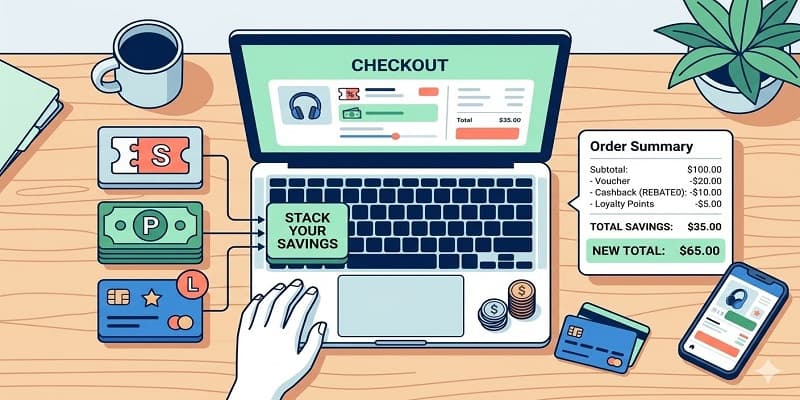
Stack Your Savings: How to Combine Codes, Cashback and Loyalty Points
15 June 2026 · 2 min read
Most people use one discount at a time — a code at checkout, maybe a cashback site if they remember it exists. But the people who consistently pay less than everyone else aren't finding secret codes. They're just stacking the ordinary ones properly.
Why stacking works
A retailer's discount, a cashback network's commission, and a card provider's reward points all come from different pots of money. The voucher code lowers what you pay the retailer. The cashback comes from the retailer paying a commission to the network for sending them a customer, some of which gets passed back to you. The points come from your bank or credit card, who make money elsewhere. None of these three parties know about, or care about, the other two. That's the whole trick — there's no reason they should cancel each other out.
The order that actually matters
Get this sequence wrong and you'll lose the cashback, which is usually the biggest chunk:
- Start from the cashback site or browser extension, not the retailer's homepage
- Click through to the retailer from there — this is what gets you tracked
- Apply your voucher code at checkout as normal
- Pay with a rewards card if you have one and can clear the balance in full
Do it in a different order — say, opening the retailer's app directly because it's faster — and the cashback network never sees that you were referred, so it won't pay out.
Where stacking usually breaks down
Two things kill a stack more often than anything else. First, ad blockers and some privacy extensions quietly strip the tracking parameters that cashback sites rely on, so the click never registers. If cashback keeps going "missing," that's usually why. Second, a lot of codes are explicitly restricted to full-price items, so if cashback tracked but the code didn't apply, check the terms before assuming it's broken.
A worked example
Say a coat is £80. A 10% code brings it to £72. A cashback site offering 5% pays you back roughly £3.60 a few weeks later, once the retailer confirms the sale (returns can void this, which is worth knowing before you order three sizes to try on). A card that gives 1% back on top adds another 72p. None of that is life-changing on its own, but on a big purchase, or across a year of ordinary shopping, it adds up to real money for genuinely no extra effort.
The one rule that saves you from disappointment
Don't let the promise of a stack talk you into buying something you weren't already planning to buy. A 15% total saving on something you didn't need isn't a saving — it's just spending with extra steps. Stack on purchases you'd already made; treat it as a discount, not a reason.